
Home / Product
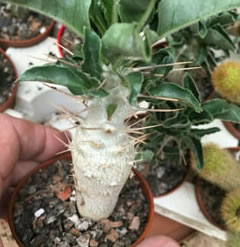
Pachypodium saundersii , kudu lily, rathbonia
€12.95
Pachypodium Saundersii , Kudu Lily, Rathbonia
Trunk approx. 3-4 inches in height
Provided with care and growing guide
The plant you receive will be similar in size and shape to the ones in the photos
Description:
Pachypodium lealii subs. saundersii (best known as Pachypodium saundersii) is a fat pot-bellied stem-succulent.
It is one of commoner Pachypodiums in cultivation.
It produces terminal clusters of large white flowers tinged with purple, they are long-tubed and adapted to pollination by moths.
Stem:
Shrubby, 1-2 metres high and wide (wild), up to approx 1 x 1 m (garden), with a ball-shaped bole (tuber), up to 1 m in diameter, often irregularly shaped, rising little above the ground, little-branched.
Branches erect, simple or sparingly re-branched above, densely spinous, thick at the base and tapering rapidly to 5-10 mm in diameter, glabrous, with a thin, papery greyish bark, deeply longitudinally wrinkled on drying.
Short shoots (branchlets), with crowded slender spines up to 1 cm long, present in axils of main stem leaves.
Leaves:
Subsessile (Petiole 0�3 mm long), spirally arranged on young branches or tufted near ends of axillary branchlets (abbreviated axillary shoots), oblanceolate, obovate to obovate-elliptic, apex obtuse and mucronate or acute, constricted towards the base, with spinulous margins, 25�80 mm long, 10�25 mm broad, thin-textured, drying blackish, often ephemeral. Hairless except for fine down on the midrib.
The latter raised, other nerves usually obscure. Leaf sometimes strongly undulate.
Stipular spines:
Spines on long shoots in spreading pairs, up to 2-3.7 cm long, stout, glabrous, straight, angled slightly upwards, with confluent swollen bases arising from a small cushion; a third, much smaller, spine also usually present proximal to the petiole. Spines on the short axillary shoots shorter.
Inflorescences (cymes):
Terminal, sessile or subsessile , several-flowered, very condensed. Pedicels hardly any or up to 2-4 mm long. Axes glabrous.
Bracts small, lanceolate, early deciduous.
Flowers:
Large showy, white, tinged with pink to purple on outside of corolla, greenish within. Calyx 3-4 mm long, glabrous. Sepals ovate, acutely acuminate. Corolla white, tinged with pink.
Tube 30-42 mm long, narrow in the lowest third below the stamens (for 10-12 mm), widened above them, then attenuate towards the mouth, externally glabrous, hairy within. Corolla lobes obliquely obovoid to almost triangular, asymmetrical, 1/2-2/3 as long as tube, much narrowed at the base, almost 2.5 cm long and wide, both surfaces glabrous.
Stamens 5; anthers sessile, inserted at base of swollen part of corolla tube, 9-11 mm long, united in a cone, subsessile. Disc cupular, deeply 5-lobed. Ovary of 2 free carpels.
Style 1, slender filiform, glabrous, attached to the two carpels at their apices. Style 2-lobed, stigma cylindrical with a basal rim.
Blooming season:
It flowers in autumn at the end of the summer growing season.
It generally blooms at a younger age than other Pachypodiums, typically around 4-5 years old.
Fruits:
The fruit is a twin horn-like cylindrical follicle (two separate mericarps), spreading at a right angle when mature, spindle-shaped, attenuate at the apex, compressed, glabrous, pale to dark-brown with longitudinal lines or lenticellate outside, 8-10(-15) cm long, 1 cm in diameter, dehiscent.
Seeds:
Numerous 6-7(-9) mm long, ovate in outline, compressed, with a apical coma (tuft of whitish or pale golden silky hairs) at one end, up to 2-2.5 cm long
Trunk approx. 3-4 inches in height
Provided with care and growing guide
The plant you receive will be similar in size and shape to the ones in the photos
Description:
Pachypodium lealii subs. saundersii (best known as Pachypodium saundersii) is a fat pot-bellied stem-succulent.
It is one of commoner Pachypodiums in cultivation.
It produces terminal clusters of large white flowers tinged with purple, they are long-tubed and adapted to pollination by moths.
Stem:
Shrubby, 1-2 metres high and wide (wild), up to approx 1 x 1 m (garden), with a ball-shaped bole (tuber), up to 1 m in diameter, often irregularly shaped, rising little above the ground, little-branched.
Branches erect, simple or sparingly re-branched above, densely spinous, thick at the base and tapering rapidly to 5-10 mm in diameter, glabrous, with a thin, papery greyish bark, deeply longitudinally wrinkled on drying.
Short shoots (branchlets), with crowded slender spines up to 1 cm long, present in axils of main stem leaves.
Leaves:
Subsessile (Petiole 0�3 mm long), spirally arranged on young branches or tufted near ends of axillary branchlets (abbreviated axillary shoots), oblanceolate, obovate to obovate-elliptic, apex obtuse and mucronate or acute, constricted towards the base, with spinulous margins, 25�80 mm long, 10�25 mm broad, thin-textured, drying blackish, often ephemeral. Hairless except for fine down on the midrib.
The latter raised, other nerves usually obscure. Leaf sometimes strongly undulate.
Stipular spines:
Spines on long shoots in spreading pairs, up to 2-3.7 cm long, stout, glabrous, straight, angled slightly upwards, with confluent swollen bases arising from a small cushion; a third, much smaller, spine also usually present proximal to the petiole. Spines on the short axillary shoots shorter.
Inflorescences (cymes):
Terminal, sessile or subsessile , several-flowered, very condensed. Pedicels hardly any or up to 2-4 mm long. Axes glabrous.
Bracts small, lanceolate, early deciduous.
Flowers:
Large showy, white, tinged with pink to purple on outside of corolla, greenish within. Calyx 3-4 mm long, glabrous. Sepals ovate, acutely acuminate. Corolla white, tinged with pink.
Tube 30-42 mm long, narrow in the lowest third below the stamens (for 10-12 mm), widened above them, then attenuate towards the mouth, externally glabrous, hairy within. Corolla lobes obliquely obovoid to almost triangular, asymmetrical, 1/2-2/3 as long as tube, much narrowed at the base, almost 2.5 cm long and wide, both surfaces glabrous.
Stamens 5; anthers sessile, inserted at base of swollen part of corolla tube, 9-11 mm long, united in a cone, subsessile. Disc cupular, deeply 5-lobed. Ovary of 2 free carpels.
Style 1, slender filiform, glabrous, attached to the two carpels at their apices. Style 2-lobed, stigma cylindrical with a basal rim.
Blooming season:
It flowers in autumn at the end of the summer growing season.
It generally blooms at a younger age than other Pachypodiums, typically around 4-5 years old.
Fruits:
The fruit is a twin horn-like cylindrical follicle (two separate mericarps), spreading at a right angle when mature, spindle-shaped, attenuate at the apex, compressed, glabrous, pale to dark-brown with longitudinal lines or lenticellate outside, 8-10(-15) cm long, 1 cm in diameter, dehiscent.
Seeds:
Numerous 6-7(-9) mm long, ovate in outline, compressed, with a apical coma (tuft of whitish or pale golden silky hairs) at one end, up to 2-2.5 cm long
Product code: 454
The catalogue and product pages are now connected. Cart and checkout integration will be completed as the next stage.